
Free Used Car Inspection Checklist + Downloadable PDF Ready for Printing
Check the car in a practical order. Record concerns, keep track of unknowns, and take better questions to a mechanic.
3 pages · US Letter · No email required · Updated October 20, 2026
Keep a record of what you find
Choose a status for each check. “No concern noticed” does not rule out a hidden fault. Leave anything you cannot inspect as “Not checked” and discuss it with an independent mechanic.
Your selections stay on this page only. Reloading or leaving clears them. Print your responses before you go.
 View the print-ready worksheet
Your used car inspection checklist
Clear all selections? This cannot be undone.
1. Before the viewing: identity and history
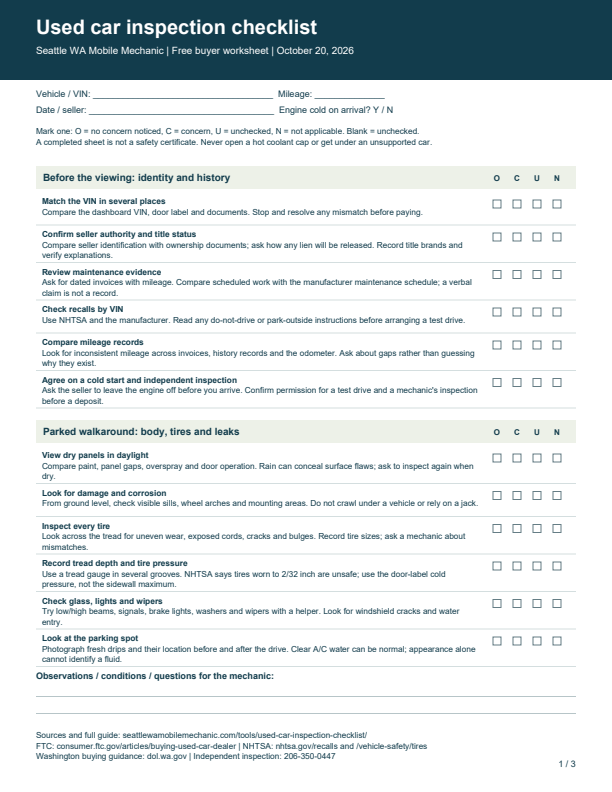
Compare the dashboard VIN, door label and documents. Stop and resolve any mismatch before paying.
Compare seller identification with ownership documents; ask how any lien will be released. Record title brands and verify explanations.
Ask for dated invoices with mileage. Compare scheduled work with the manufacturer maintenance schedule; a verbal claim is not a record.
Use NHTSA and the manufacturer. Read any do-not-drive or park-outside instructions before arranging a test drive.
Look for inconsistent mileage across invoices, history records and the odometer. Ask about gaps rather than guessing why they exist.
Ask the seller to leave the engine off before you arrive. Confirm permission for a test drive and a mechanic's inspection before a deposit.
2. Parked walkaround: body, tires and leaks
Compare paint, panel gaps, overspray and door operation. Rain can conceal surface flaws; ask to inspect again when dry.
From ground level, check visible sills, wheel arches and mounting areas. Do not crawl under a vehicle or rely on a jack.
Look across the tread for uneven wear, exposed cords, cracks and bulges. Record tire sizes; ask a mechanic about mismatches.
Use a tread gauge in several grooves. NHTSA says tires worn to 2/32 inch are unsafe; use the door-label cold pressure, not the sidewall maximum.
Try low/high beams, signals, brake lights, washers and wipers with a helper. Look for windshield cracks and water entry.
Photograph fresh drips and their location before and after the drive. Clear A/C water can be normal; appearance alone cannot identify a fluid.
3. Engine off and cool: under the hood
If fitted, check oil using the specified procedure. Note low level, contamination or burnt smell without diagnosing from color alone.
Check level only when cool and as the manual directs. Never remove a hot cooling-system cap.
With the engine off, look for wet connections, cracks and fraying. Keep hands away from fans, which may start unexpectedly.
Note visible seepage, deposits and freshly cleaned areas. A clean engine bay does not establish that it is leak-free.
Look for corrosion, loose mounting, swelling and damaged cables without touching terminals. A successful start is not a battery health test.
Ask about timing-belt history if fitted. EV/hybrid buyers need battery-health and charging checks; never touch orange high-voltage components.
4. Cabin and first start
Inspect accessible carpet edges, cargo floor and spare-wheel well. Mustiness, stains or heavy fragrance warrant questions, not a flood diagnosis.
Check accessible belt webbing and buckles, seat adjustment, doors, windows and locks. Ask about missing keys.
Try heat, A/C and front/rear defrost where fitted. Weak demisting matters in Seattle rain; note conditions when testing cooling.
Follow the manual's key-on sequence. Note lights that fail to illuminate or remain on, including engine, ABS and airbag warnings.
From a safe position, note extended cranking, rough idle, knocking or stalling. Record whether the engine was already warm on arrival.
Note persistent smoke after warm-up, unusual smells and temperature warnings. Brief cold-weather vapor alone does not prove a fault.
5. Test drive: only if safe and permitted
Agree on insurance and a lawful route. Do not drive with fuel leaks, damaged tires, brake concerns or a recall instruction prohibiting driving.
With both hands controlling the wheel, note clunks, binding or unusual effort. Never release the wheel to test tracking.
Note hesitation, flare in engine speed, harsh shifts or shudder. Use normal inputs; do not perform aggressive acceleration tests.
In safe traffic conditions, note pulling, grinding, vibration or a soft pedal. Stop the drive safely if braking feels unreliable.
On a safe legal route, note vibration, humming and wind/water leaks. Do not use a phone while driving; let a passenger take notes.
Note new drips, smells, warning lights and hot restart behavior. Do not touch hot parts or open a hot coolant cap.
6. Before committing: resolve the unknowns
Record location, conditions and timing: for example, steering-wheel vibration during light braking. Avoid guessing the failed part.
A missed cold start, inaccessible underside or unavailable charging test remains unknown, even if everything else seemed fine.
Ask for the VIN, findings, inspection limits and repair estimates. Clarify whether a lift, road test and diagnostic scan are included.
A code-free scan cannot rule out mechanical damage. Incomplete readiness monitors can have several causes; request follow-up instead of assuming fraud.
Discuss safety repairs, overdue maintenance and cosmetic work separately. Get vehicle-specific estimates before negotiating.
Get promises in writing. For Washington private sales, review DOL guidance and consider meeting at a vehicle licensing office.
Concerns to discuss
No concerns marked yet. Unchecked items still need follow-up.
Ask a mechanic to assess concerns and unknowns before committing. A count is not a purchase recommendation.
Arrange a used car pre purchase inspectionBefore you meet the seller
Bring a flashlight, tire tread gauge, tire pressure gauge, paper towel and the PDF or your phone. Ask for a daylight viewing on level ground, permission to drive, and a cold engine on arrival. Allow time to check the car without rushing into payment. Check the owner’s manual for procedures specific to that vehicle.
If you arrive and the engine is warm, write “cold start not checked.” A warm engine is an observation to follow up, not proof that a seller is hiding something. Likewise, a recently cleaned engine bay or new battery needs context. Ask what was done and request the invoice.
How to turn a concern into a useful mechanic’s note
Record what happened, when it happened, and what you could not check. An observation is more useful than naming a part you have not tested.
Example, not a customer case: “Steering wheel vibrates during light braking after the car warms up. No vibration noticed while coasting on the same road. Cold start not checked because the engine was warm on arrival.” Hand that note to the inspector. It gives them a condition to reproduce without assuming the brake rotors are the cause.
Keep photos of visible damage with the seller’s permission. For noises, let a passenger make notes; do not handle a phone while driving. Ask for written findings and vehicle-specific repair estimates before using an issue to negotiate.
Stop the drive, pause the purchase, or plan a repair?
Stop a test drive for an immediate safety concern
Fuel smell or leakage, exposed tire cords, tire bulges, unreliable braking, overheating, or a serious warning instruction need attention before further driving. If already driving, stop somewhere safe. An open recall can have specific instructions: read them rather than assuming every recalled vehicle has the same risk. Use the NHTSA VIN recall lookup and check the manufacturer too; the lookup has coverage limitations.
Pause payment for unresolved ownership or damage questions
A VIN mismatch, uncertain seller authority, unclear lien release, suspected structural damage or refusal of an independent inspection calls for verification before money changes hands. The checklist cannot establish clear title or rule out flood damage. Washington buyers can use the Department of Licensing’s vehicle buying guidance for current paperwork steps.
Get estimates for maintenance and smaller defects
Worn wiper blades and an overdue scheduled service are different from an unresolved brake fault. List each separately. A seller’s price reduction does not establish that a car is safe, and a budget for one repair may not cover the underlying cause. If a warning appears, our guide to driving with the check engine light on explains why the light’s behavior and symptoms matter.
Seattle viewing checks that are easy to miss
Rain can make a quick viewing less revealing. Look at paint when dry and inspect accessible carpet, the cargo floor and spare-wheel well for dampness. Water in one location can come from a leak; it does not establish flood history. Ask where the car has lived and compare the answer with records.
Try the wipers, washers, heater and demister before a wet drive. A car that runs well can still have poor visibility. For tires, inspect the whole tread rather than just the outside edge. NHTSA’s tire guidance says tread at 2/32 inch is unsafe. That is a replacement threshold, not a promise of good wet-road grip above it. Check the manufacturer’s tire requirements and the pressure label on the vehicle.
What this buyer checklist cannot tell you
You cannot confirm internal engine condition, transmission health, structural integrity, airbag repairs or EV battery capacity from a walkaround. Underbody access, specialized tests and vehicle-specific expertise may be needed. A scan is one input: no fault codes does not mean no faults. Recently reset readiness monitors need explanation and follow-up; they do not establish dishonesty on their own.
The FTC recommends an independent mechanical inspection, even for a dealer-certified car, and explains that a history report is not a substitute. For help locally, arrange a used car pre purchase inspection and ask what access, road testing and diagnostics can be included at the seller’s location. Some checks may require a shop or lift.
Frequently asked questions
Is the printable checklist really free?
Yes. Download the blank three-page US Letter PDF without providing an email or booking a service. It has all 36 checks, status columns, vehicle details and space for observations. Print at actual size on Letter paper; use “fit” for A4. You can also print your selected web responses using the print button.
Does completing every check mean I should buy the car?
No. “No concern noticed” records your observation, not a professional pass. A completed list can still miss hidden damage. Use the concerns and unchecked items to brief an independent mechanic, then consider the written findings, ownership records and full purchase costs before deciding.
What if the seller refuses an independent inspection?
Ask whether the obstacle is taking the car off-site and whether a mobile inspection would work instead. If no independent inspection is permitted, you cannot resolve that uncertainty with a history report or this checklist. The FTC advises considering another dealer when a dealer will not allow one.
Is this suitable for an electric or hybrid car?
The body, paperwork, cabin and tire checks still help, but engine-related checks may not apply. Mark them “Not applicable.” Arrange specialist checks for battery health, charging operation, thermal management and high-voltage systems. Displayed range alone cannot establish usable battery capacity. Leave high-voltage cables and components untouched.
Does a model’s recall count tell me whether this car is safe?
No. A model-level count does not establish whether a particular vehicle has an unrepaired recall. Check its VIN and follow the remedy or interim instructions. Our guide to the most recalled cars in 2025 explains why campaign totals are not a safety ranking.
Maintained by Seattle WA Mobile Mechanic. Reviewed October 20, 2026. Buyer education; no individual vehicle has been inspected through this page.